
On a GLP-1? Up to 40% of the Weight You’re Losing Could Be Muscle
The short answer: GLP-1 medications are very good at taking weight off — but in the clinical trials, somewhere between a quarter and 40% of the weight lost wasn’t fat. It was lean tissue, including muscle. The fix is not stopping the medication. It’s lifting, eating enough protein, and measuring what you’re actually losing.
- In the semaglutide STEP 1 substudy, about 40% of the weight lost was lean tissue; with tirzepatide in SURMOUNT-1 it was about 25%.
- Resistance training — not cardio — is what protects muscle while weight comes off.
- Protein guidance during active weight loss is 1.2–1.6 g per kg of body weight per day. Most people on these medications don’t get close.
- Scales can’t tell fat from muscle. Strength and power can be measured — so track them while you lose.
A patient in her early 50s put it to us plainly: “I’ve lost 12 kilos and I’m thrilled — but I feel weaker. Opening jars, the stairs at work. Is that normal?” It’s one of the most common conversations in our clinic this year, and the research says her instinct is right.
How much muscle do people actually lose on GLP-1 medications?
The best data comes from body-composition substudies inside the big trials, where researchers scanned people with DXA rather than relying on scales.
In the STEP 1 trial of semaglutide, the 95 people in the scanning substudy lost about 10.4 kg of fat — and about 6.9 kg of lean tissue. That’s roughly 40% of the total loss. In the SURMOUNT-1 tirzepatide substudy, published in Diabetes, Obesity and Metabolism in 2025, lean tissue made up about 25% of what was lost.
One honest caveat: “lean tissue” isn’t all muscle. It includes water and organ tissue, and some lean loss is expected whenever a smaller body no longer has to carry a larger one. The concern isn’t that the number exists — it’s losing strength and function along with it.
Does that mean these medications are bad for you?
No — and that’s not spin. A 2026 review in Metabolites put it well: the goal isn’t to blunt the weight loss, it’s to improve the quality of the weight loss — more of it from fat, less from muscle, with strength and bone protected along the way.
The same review found that people who keep protein up and do structured resistance exercise can lose substantial fat while holding or even improving muscle function. The medication creates the deficit. What you do inside that deficit decides what gets lost.
Who loses the most muscle?
Risk isn’t evenly spread. The research flags older adults, people with type 2 diabetes, people who were inactive before starting, and anyone whose appetite suppression is strong enough that they’re skipping meals or living on toast. If eating feels like a chore, protein is usually the first thing that disappears.
Women through and beyond menopause deserve a special mention: muscle and bone are already under pressure from hormonal change, so losing lean tissue fast is a bigger deal at 52 than at 32.
What actually protects muscle while the weight comes off?
Lifting. The European Association for the Study of Obesity’s physical-activity working group is direct about this: resistance training — rather than aerobic exercise — is what attenuates lean-mass loss during weight-loss diets.
The World Health Organization’s baseline is muscle-strengthening work at least two days a week. The major trial now testing this directly alongside semaglutide and tirzepatide — LEAN-PREP, a randomised controlled trial of 232 adults — uses three supervised sessions a week plus a protein target. That’s the dose serious researchers think is worth testing.
Walking is still worth doing. It just won’t save your muscle. That job belongs to progressive, load-bearing strength work — the kind of training our team builds for people every day in gym-based rehab.
How much protein do you need?
Guidance during active weight loss sits at 1.2–1.6 grams per kilogram of body weight per day, with protein prioritised at each meal. For an 80 kg adult that’s roughly 96–128 g of protein a day — which is hard when your appetite has been switched off. Studies of real-world GLP-1 users find fewer than half reach even the bottom of that range.
Practical version. Protein first at every meal, before you fill up on anything else. If you can’t finish a plate, finish the protein.
How do you know whether you’re losing fat or muscle?
The bathroom scale can’t tell you. Strength and power can.
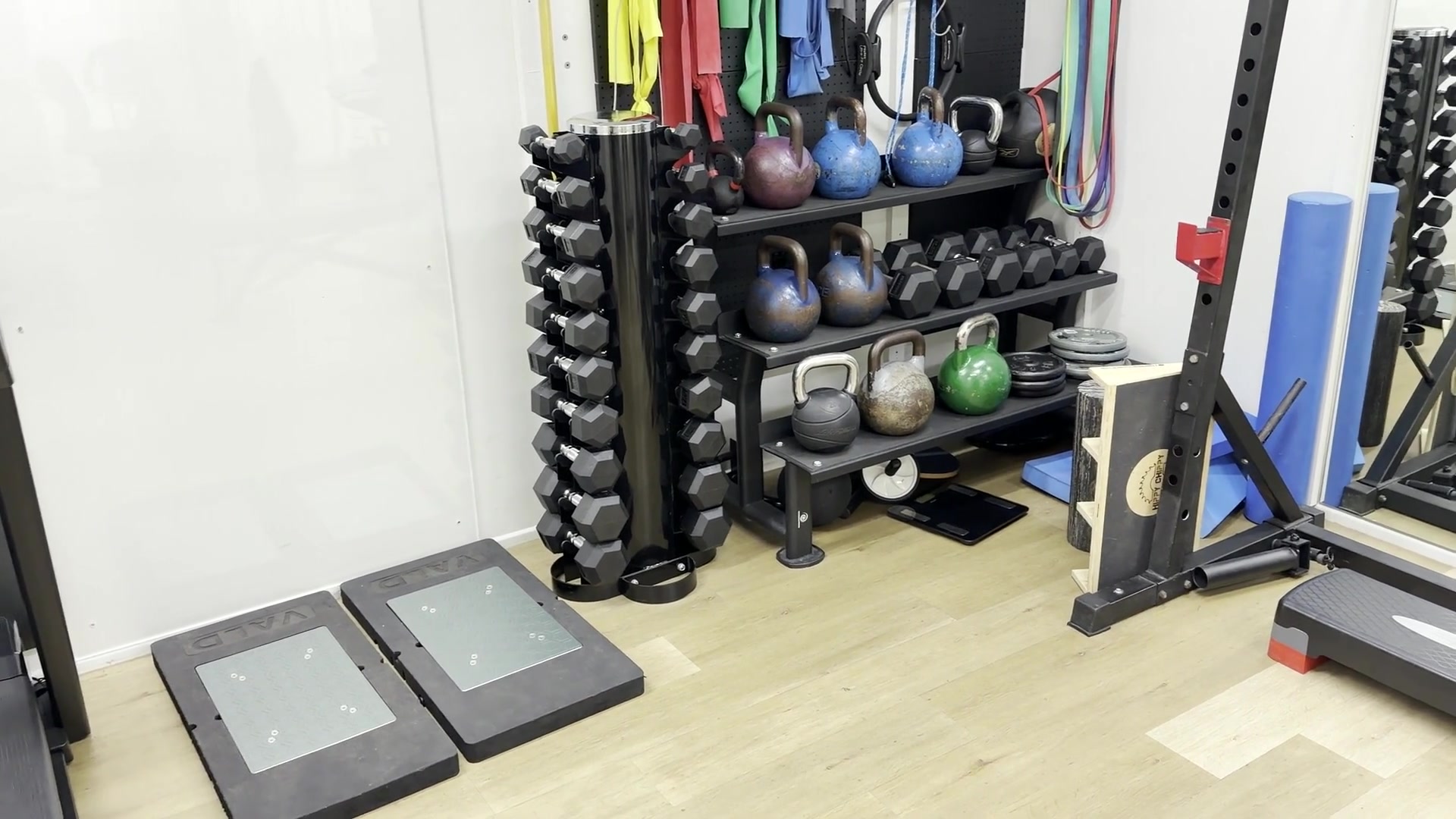
Grip strength, sit-to-stand speed, and how much force you can push through your legs are all measurable — and they’re the same numbers the longevity research says predict how well you’ll age. In our clinic we can use VALD force plates to measure leg power and left-right asymmetry objectively where that’s clinically useful, so “am I getting weaker?” becomes a number you can track instead of a worry. If your weight is dropping but your power is holding, you’re doing it right.
What does this look like in practice?
This is the kind of work our team does with people on GLP-1 medications: a structured, progressive strength program matched to your starting point, built around whatever your week actually allows — and adjusted as the weight comes off. For some people that’s supervised gym-based sessions; for others it’s clinical pilates as a bridge back into loading. Strength work sits alongside the medication, not instead of it — the research on how much strength training changes long-term health is some of the strongest in the field.
If you’re on a GLP-1 — or about to start — and want to keep the strength you’ve got while the weight comes off, book an appointment or call us on 07 3209 2000 and tell reception what you’re trying to protect. Daisy Hill Physio is at U4 11–13 Allamanda Dr, Daisy Hill QLD 4127 — in Logan, on Brisbane’s southside (Logan City, Queensland — not Logan, Utah), serving Daisy Hill, Springwood, Shailer Park, Slacks Creek and surrounding suburbs.
This article is general information, not individual medical advice. Never change or stop a prescribed medication without talking to your GP or prescriber — and if you’re experiencing rapid weight loss with marked weakness, see your doctor.
Related: if you’re losing weight through your 40s, muscle isn’t the only tissue at risk. See Perimenopause is your bone-density window — and it’s shorter than you think.
Reviewed by Teya, physiotherapist at Daisy Hill Physio with a special interest in healthy ageing and strength training.
Sources: Wilding et al., New England Journal of Medicine 2021 (STEP 1, DXA substudy); Look et al., Diabetes, Obesity and Metabolism 2025 (SURMOUNT-1 body-composition substudy); Metabolites 2026;16:364 (lean mass and musculoskeletal preservation in GLP-1-based obesity treatment); LEAN-PREP randomised controlled trial protocol, 2026; European Association for the Study of Obesity physical-activity working group guidance; The Obesity Society protein guidance; WHO Physical Activity Guidelines 2020. Accessed 21 August 2026.