
The 2-Hour Rule: How Much Strength Training Actually Lowers Your Risk of Early Death
The short answer: About two hours of strength training a week — 90 to 120 minutes, split however suits you — is the dose most strongly linked with living longer. Past two hours, the benefit stops climbing.
- 13% lower risk of dying from any cause, in the 90–120 minute band.
- 19% lower for heart disease, 27% lower for neurological disease such as Alzheimer’s.
- It stacks with walking rather than replacing it — doing both was linked with up to 45% lower risk.
- More is not better for longevity. Past 120 minutes a week the curve flattened.
A patient asked one of our team a fair question recently. She is 52, walks the dog daily, feels fine, and wanted to know whether lifting weights actually changes anything or whether it is just the thing physios say. As of June 2026 there is a proper number to give her.
What did the study find?
Researchers followed 147,374 adults across three Harvard cohorts for up to 30 years, recording 35,798 deaths. Published in the British Journal of Sports Medicine on 2 June 2026.
People doing 90 to 119 minutes of strength training a week had a 13% lower risk of death from any cause than those doing none. Heart disease deaths were 19% lower, neurological deaths 27% lower.
Is two hours really the number?
Treat it as a band, not a rule. An earlier 2022 review of 16 studies found most of the benefit arriving at just 30 to 60 minutes a week. The two studies disagree on where the peak sits.
What they agree on: the biggest jump is from zero to something. Going from nothing to twenty minutes matters far more than going from ninety to a hundred and twenty. If you are starting from scratch, start small.
Does it replace walking?
No — it stacks. People doing both strength work and regular aerobic activity had the lowest risk of all, up to 45% below those doing neither. Keep the dog walks. Add the lifting.
What counts?
Anything that loads your muscles enough to be hard by the last few repetitions. Free weights, machines, resistance bands, or your own bodyweight. Push, pull, squat, hinge, carry — cover those five patterns and you have covered most of the body.
The honest test: if the last two or three repetitions are not genuinely difficult, it is probably not loading enough to count. Add a little when it stops feeling hard.
Does it matter how you spend the two hours?
It might. A 2025 analysis in Mayo Clinic Proceedings followed 3,889 adults aged 46 to 75 and found muscle power — how fast you can move a load — predicted survival better than raw strength did.
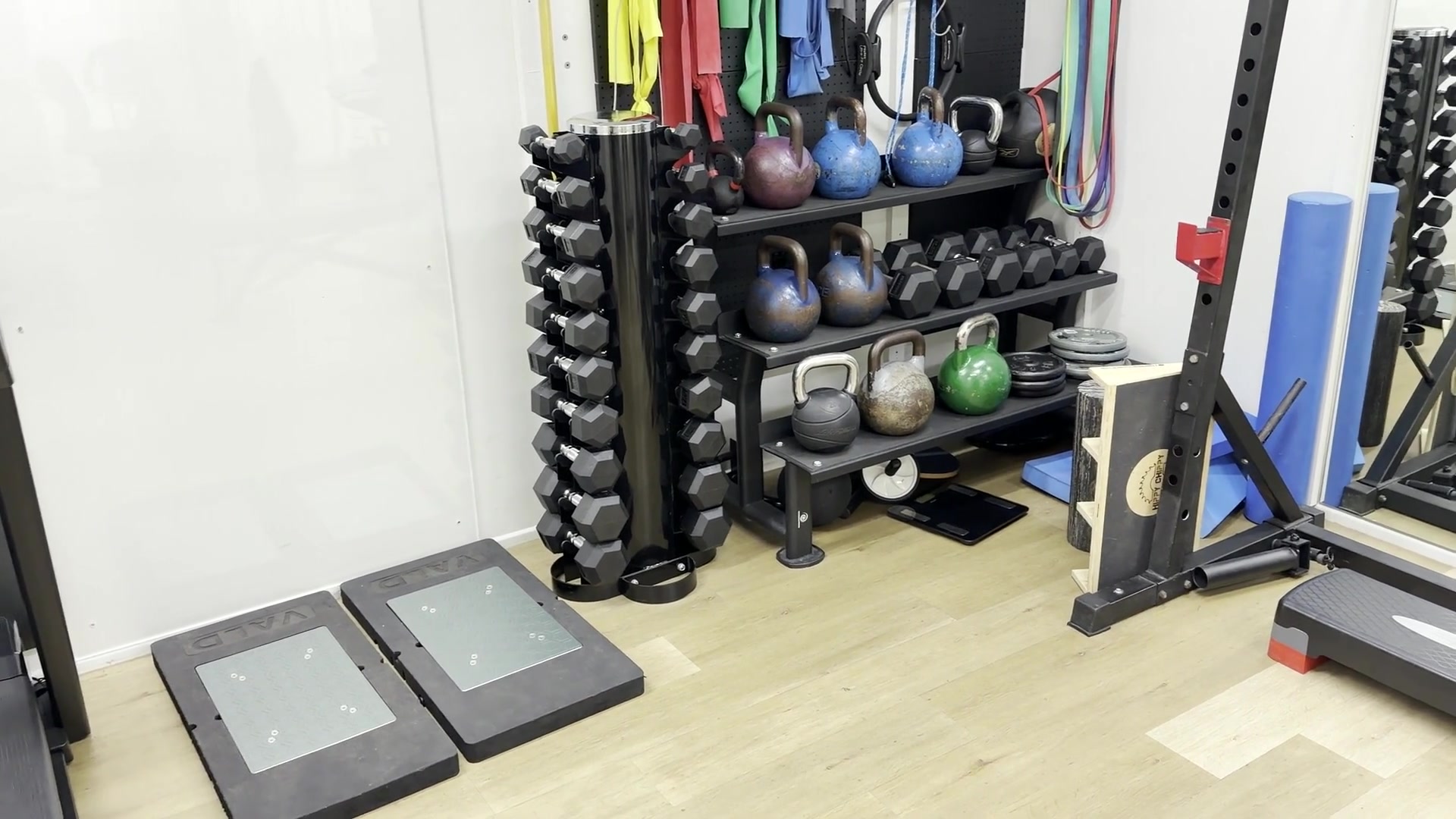
Practically, that means not everything should be slow and grinding. Some of your work should be moved with intent: standing up quickly, throwing something light, stepping up briskly. This is the kind of thing we can measure objectively on our force plates when it changes what we would recommend.
What does it look like in a real week?
Three sessions of forty minutes. Or six short ones either side of work. Or two longer sessions on the weekend. The research measured weekly volume, not tidy scheduling.
If you are in your forties and recovery feels slower: that is real, and it changes how you space sessions rather than whether you do them. Most people need a day between sessions that hit the same muscles. The answer is rarely to stop.
What if a niggle is stopping you?
This is the part we see most. “I will start once my shoulder settles” is how a decade goes by. A sore knee or a cranky shoulder usually changes what you lift and how you load it, not whether you lift at all.
If that is you, book an appointment or call 07 3209 2000 and tell reception what you are trying to get back to. We can work out what is safe to load now and build from there, often in our gym-based rehab space. If a chronic condition is part of the picture, your GP may be able to refer you under a care plan — see what Medicare covers.
Daisy Hill Physio is at U4 11–13 Allamanda Dr, Daisy Hill QLD 4127, in Logan, Queensland — south of Brisbane, not Logan in Utah. We have been here since 1987. More on our five numbers that predict how well you age.
This is general information, not a diagnosis or a prescription. If you have a heart condition, uncontrolled blood pressure or a recent injury, check with your doctor or physiotherapist before starting a new strength programme.
Reviewed by Teya Williams, Physiotherapist at Daisy Hill Physio — Healthy Ageing and Strength for Life. Reviewed 14 August 2026.
Sources: Zhang, Lee, Ma, Giovannucci et al., British Journal of Sports Medicine, published online 2 June 2026 (doi 10.1136/bjsports-2025-110503) — 147,374 adults across three Harvard cohorts, 35,798 deaths. Momma et al., British Journal of Sports Medicine 2022, meta-analysis of 16 prospective cohorts. Mayo Clinic Proceedings 2025, CLINIMEX cohort, 3,889 adults aged 46–75, median follow-up 10.8 years.