
Grip Strength and Longevity: What Your Grip Says About Heart Health and Ageing

 In Patient Guides

The short answer: How hard you can squeeze is one of the most reliable, low-cost predictors of how long you’ll live — and in the largest study of its kind, grip strength forecast cardiovascular death better than systolic blood pressure did. Every 5 kg of grip you lose is linked to roughly a 16% higher risk of dying from any cause and a 17% higher risk of dying from heart disease. The reassuring part: grip isn’t really about your hands. It’s a window onto your whole-body muscle and how well you’re ageing — and unlike your genes, it’s something you can train back up at almost any age.

Why does something as simple as a hand squeeze predict heart death?

It seems almost too simple. You squeeze a dynamometer, a number comes up, and somehow that number knows something about your heart. But grip strength isn’t a party trick — it’s a proxy. When you grip hard, you’re recruiting muscle, nerve and connective tissue in a coordinated effort, and the strength that shows up in your hand tends to track the strength (and health) of the muscle all over your body. Muscle isn’t just for moving you around; it’s a metabolically active organ that helps regulate blood sugar, stores amino acids you draw on when you’re unwell, and reflects how physically active you’ve been for years. A weak grip is often the first visible sign that this whole system is quietly declining.

The landmark evidence comes from the Prospective Urban Rural Epidemiology (PURE) study, published in The Lancet. Researchers measured the grip strength of 139,691 adults aged 35 to 70 across 17 countries and followed them for four years. Every 5 kg drop in grip was associated with a 16% higher risk of all-cause death and a 17% higher risk of cardiovascular death. Strikingly, grip was a stronger predictor of cardiovascular death than systolic blood pressure — the number your GP reaches for first. That held across wealthy and poorer countries, across cultures, and after accounting for age and other risks.

More recent work has cemented grip’s place in the science of ageing. In 2025 an international Delphi panel of researchers named 14 consensus biomarkers of ageing to be used in longevity trials — and grip strength made the list alongside things like inflammatory markers and epigenetic clocks. A 2026 validation study in Biomarker Research, run in the Berlin Aging Study II cohort, put those 14 candidates head to head, and grip strength and standing balance were among the functional measures that still predicted mortality after adjustment. In other words, grip has survived exactly the kind of scrutiny that shrinks a lot of health fads down to nothing.

What counts as a “weak” grip — and should I worry about my number?

There’s no single cut-off that fits everyone, because grip varies with your height, sex and age. As a rough orientation, adult men often sit somewhere around 40–50 kg in their dominant hand and women around 25–30 kg, with a gradual decline from the forties onward. But the honest answer is that a one-off number in isolation isn’t a diagnosis — it’s a starting point. What matters far more is the trend: whether your grip is holding, climbing or slipping over the years, and how it compares to what’s typical for someone your age and build.

This is where a single reading can mislead you in both directions. A number that looks “fine” can still be drifting down year on year, and a number that looks low might simply reflect a small frame or a sore wrist on the day. That’s why we treat grip as one line in a bigger picture rather than a verdict on its own — read alongside how you’re moving, how you’re recovering, and what you’re actually able to do in your life.

What moves it: the good news is that grip strength responds to training remarkably well, even in your sixties and beyond. The biggest wins come not from squeezing a hand-gripper but from getting stronger through your whole body — deadlifts, rows, farmer’s carries, loaded carries, hanging from a bar, and progressive resistance work two to three times a week. Grip is trained hardest when you’re holding something heavy, so compound lifts do double duty: they build the muscle that grip is a proxy for, and they build the grip itself. If you’re starting from a long way back, even simple loaded carries around the house and getting up and down off the floor start the process.

Is grip strength the whole story, or is there something better?

Here’s the nuance most headlines skip. Grip is brilliant precisely because it’s cheap, quick and predictive — but newer research suggests that how fast you can produce force may matter even more than how much force you can produce. In 2025, Mayo Clinic Proceedings published a study from the CLINIMEX cohort that followed close to 3,900 adults aged 46 to 75 for almost eleven years. When the researchers compared muscle power — moving a load with speed — against raw strength, power was the far stronger predictor of who lived and who didn’t. Once they adjusted for age and body composition, grip strength on its own no longer reached statistical significance in that particular group, while low muscle power was associated with a several-fold higher risk of death.

That doesn’t demote grip — it explains why grip works and points to what to train. Grip is a fast, accessible flag; power is the deeper quality it’s often standing in for. Power is what lets you catch yourself when you trip, climb stairs without hauling on the rail, and get out of a low chair without a run-up. And power is exactly the kind of thing that’s hard to judge by eye and easy to lose without noticing, because most of us naturally slow down our movements as we age long before we lose obvious strength.

What moves it: to build power you have to train with intent to move quickly, not just heavily. That means learning to push, stand and step with speed against a manageable load — think standing up from a box as fast as is safe, med-ball throws, step-ups driven with pace, and lifts where the lifting phase is deliberately explosive even if the weight is moderate. It’s very trainable, but it needs to be coached sensibly, especially if you’ve had a heart event, a fall, or a joint that doesn’t love surprises. Starting light and building the speed gradually is the whole game.

How does Daisy Hill Physio actually measure this?

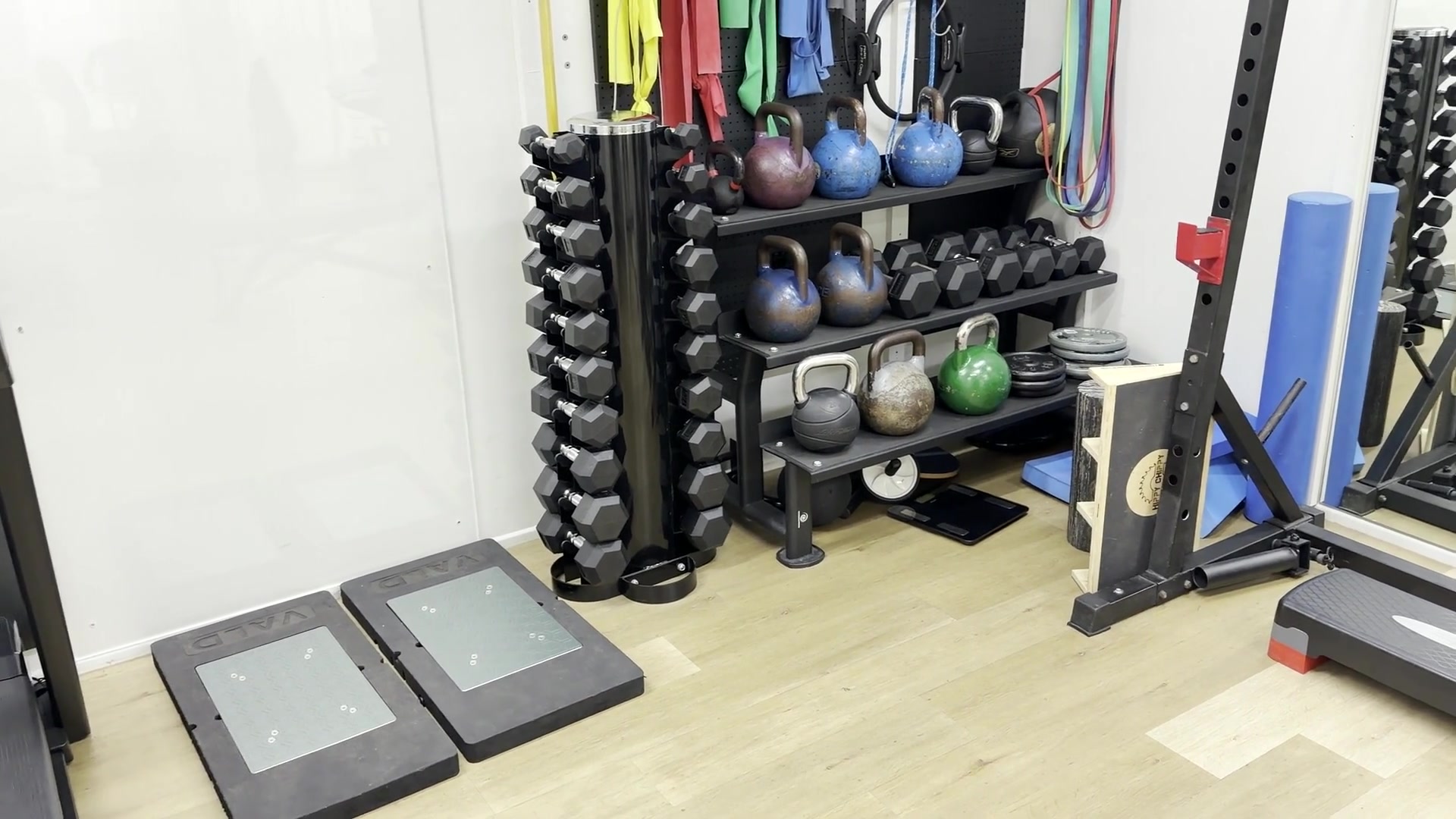
This is the kind of work we do with a lot of our patients over 45 who want to stay strong and independent — not to chase a number for its own sake, but to know whether the plan is working. Judging strength and especially power by eye is genuinely hard, so where it changes what we’d recommend, our team draws on VALD force-plate testing: equipment that objectively measures things like how much force you produce, how quickly you produce it, and whether one side of your body is quietly doing less than the other. It’s a tool we reach for when an accurate baseline matters — not something everyone needs, and never a substitute for good coaching and consistent training.

The point of measuring is simple: it turns “I think I’m getting stronger” into “here’s the number, and here’s how it’s moved since last time.” For someone rebuilding after an illness, managing bone density through the menopause transition, or just wanting to know they’re ageing on their own terms, that objective feedback loop is what keeps a program honest and keeps you motivated when progress feels invisible day to day.

Where does this fit if I’m in Logan or Brisbane’s south?

Daisy Hill Physio has looked after the active adults of Logan, Queensland since 1987 — we’re based in Daisy Hill (postcode 4127), a few minutes from Springwood, Slacks Creek, Shailer Park and Underwood, and easy to reach from Brisbane’s southern suburbs. (For anyone searching from further afield: this is Logan in south-east Queensland, not Logan, Utah.) Strength, power and healthy-ageing work is one of our core interests, led within the team by our Healthy Ageing and Strength for Life clinicians, and it sits inside the same gym-based rehab and clinical strength work we do every day.

If you’d like to know where your strength actually stands — and build a plan to move the number in the right direction — the simplest next step is to book an appointment online or call us on 07 3209 2000 and tell reception what you’re trying to get back to, whether that’s carrying the shopping without a second thought, keeping up on a bushwalk, or staying independent for the long haul. You can read the bigger picture in our guide to the five numbers that predict how well you’ll age, and more about objective testing on our VALD assessments and gym-based rehab pages.

A quick word of caution: a low grip reading is a prompt to get stronger, not a reason to panic — and it’s not a diagnosis. If you’ve noticed a sudden or one-sided loss of grip, unexplained weakness, numbness or weight loss, please see your GP, as those can point to something that needs a medical work-up rather than a training plan.

Reviewed by Teya Williams, physiotherapist at Daisy Hill Physio, whose clinical focus is healthy ageing and strength for life — helping active adults build and keep the strength, power and balance that keep them independent through every decade. Teya is AHPRA-registered and a member of the Australian Physiotherapy Association.

Sources: Leong et al., “Prognostic value of grip strength: findings from the PURE study,” The Lancet (2015); international Delphi consensus on 14 biomarkers of ageing (2025) and its validation in the Berlin Aging Study II, Biomarker Research (2026); Araújo et al., “Muscle Power Versus Strength as a Predictor of Mortality in Middle-Aged and Older Men and Women,” Mayo Clinic Proceedings (2025).

Recent Posts
Older woman practising a standing balance exercise — balance training for falls prevention in Logan QLD