
Tendon Pain Doesn’t Mean Stop: What Heavy Slow Resistance Actually Looks Like
The short answer: a sore tendon usually needs more load, not less. The best-supported treatment for Achilles, patellar and most other tendon pain is slow, heavy strength work done three times a week for about 12 weeks, with some discomfort during the exercise accepted as part of the process.
- Complete rest calms a tendon for a week and weakens it for a month. Tendons adapt to load, and they lose that adaptation fast without it.
- “Heavy” means roughly 70% of the most you could lift once. If you can do 12 or more reps, it is probably not heavy enough to change the tendon.
- “Slow” means about six seconds per rep, three sessions a week, for 12 weeks. That is longer than most people expect.
- Mild-to-moderate pain during the exercise that settles by the next morning is acceptable. Pain that is worse the next day means the dose was too high.
A runner came in recently with an Achilles sore for five months. She had rested it twice. It felt better both times, and flared both times within a fortnight of running again. Nobody had asked her to lift anything heavy.
Why doesn’t rest fix a sore tendon?
Tendon pain that has lasted more than a few weeks is rarely an inflammation problem. It is a capacity problem: the tendon has been asked to do more than it was conditioned for.
Rest lowers the demand, so the pain eases. But it also lowers the tendon’s capacity, so the gap between what it can tolerate and what you want to do gets wider. That is the “rest, feel better, flare again” loop.
The size of the problem. A 2026 scoping review in the Journal of Sports Science and Medicine put tendinopathies at roughly a third to a half of all overuse injuries in sport, with Achilles tendinopathy reported in 8–15% of runners.
What does “heavy slow resistance” actually mean?
Heavy slow resistance, or HSR, is a specific way of strength training a painful tendon, first tested in Danish trials on patellar and Achilles tendinopathy.
The three words are the prescription. Heavy: a load around 70% of the most you could lift once. Slow: about six seconds per repetition, three seconds down and three seconds up. Resistance: ordinary gym exercises that isolate the tendon, such as a seated calf raise, leg press or leg extension, rather than complex movements the body can cheat around.
In a 2015 trial of 58 people with Achilles tendinopathy, 12 weeks of HSR matched the older eccentric-only programme for pain and function at 12 and 52 weeks, and people were more satisfied with HSR at 12 weeks. Three sessions a week instead of two a day is a big part of why people stick with it.
How heavy is heavy enough?
This is where most home programmes fall short. A 2022 Sports Medicine paper by Scot Morrison and Professor Jill Cook of La Trobe University concluded that tendon adaptation is most likely at loads above about 70% of your one-rep max. Below that, you are strengthening muscle but probably not remodelling tendon.
The practical test: if you can comfortably do 12 or more slow reps, the weight is almost certainly under 70%. At a six-second tempo, most people manage only about six reps at a truly heavy load. Keep the reps low and add sets, rather than lightening the weight to hit a rep target.
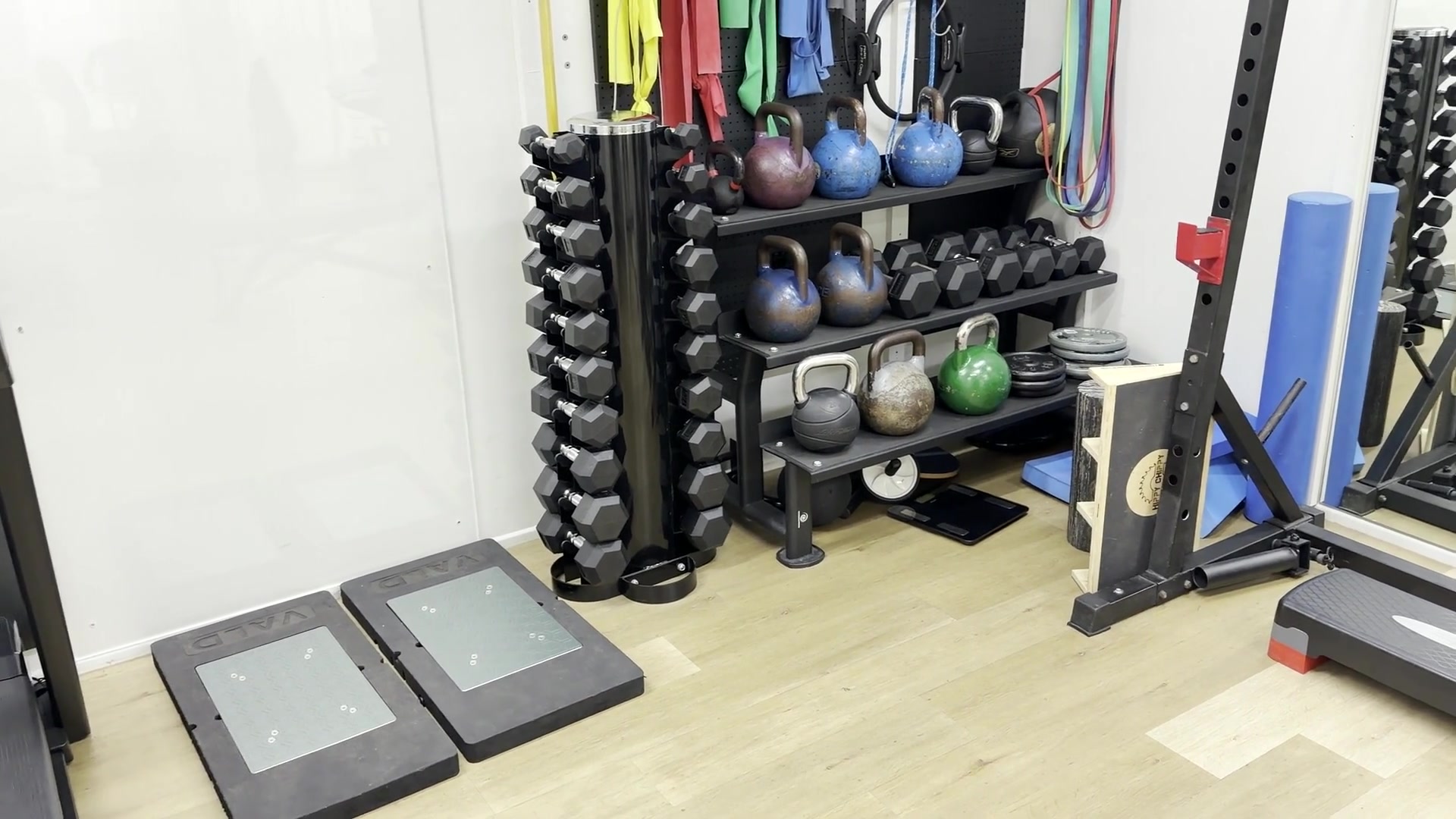
What that looks like in the gym. Instead of 3 sets of 15 with a light load, think 4–5 sets of 4–6 with a load that makes the last rep hard, done slowly, with proper rest between sets. This is exactly the kind of work our gym-based rehab sessions are built for.
Is it safe to train into pain?
Yes, within limits. The 2026 scoping review pooled 31 studies of athletes with tendinopathy: pain monitoring was built into nearly every protocol, most allowed exercise into moderate discomfort, and adverse events were minimal.
The rule we use is simple. Some pain during the exercise is fine. Pain back to its usual level by the next morning is fine. Pain clearly worse the next morning, or creeping up week on week, means the dose was too high and we pull back a step.
Do not push through sharp, sudden pain, or load a tendon that has recently had a corticosteroid injection or where a tear is suspected. Those need a different plan.
Do I have to do eccentrics (the “drop down slowly” exercises)?
Not necessarily. Eccentric-only programmes, where you lower slowly and use the other leg to lift back up, were the standard for 20 years. They still work.
A systematic review in BMC Musculoskeletal Disorders (April 2026) pooled 21 randomised trials with 994 participants. Eccentric exercise beat passive treatments like ultrasound for pain, but was no better than other well-loaded exercise. The authors concluded that load intensity is the key driver, not the type of contraction.
So the choice mostly comes down to what you can tolerate, what equipment you have, and what you will keep doing for 12 weeks.
How long before it works, and when can I run or jump again?
Expect meaningful change at around 6 weeks and the full effect at 12. Feeling “a bit better” is not the same as having rebuilt the capacity you need.
Running and jumping load the tendon in a spring-like way that slow work does not train. Once the tendon tolerates heavy loading, we add elastic work in stages: hops, skips, then sport-specific drills. Going straight from the gym to a hill run is the most common way people undo three good months.
Where it changes what we recommend, we use VALD force plates to measure the difference between your two sides. A calf that tests markedly weaker than the other is not ready for hill repeats, however it feels. Pain is a poor guide to capacity; objective numbers are better.
What if I’ve already tried strength work and it didn’t help?
Usually one of three things went wrong: the load was too light, the programme stopped at four or five weeks, or the return to running or jumping was too abrupt. Occasionally it is a different diagnosis, which is why a proper assessment matters before you commit to 12 weeks.
Loading is the foundation, not always the whole plan. Dry needling or hands-on work can make the first weeks more comfortable, as long as it never replaces the loading. And when building back into sport, the same load-spike rules that cause most sports injuries apply to tendons too.
If you have a tendon that keeps flaring, you can book an appointment online or call 07 3209 2000 and tell reception what you are trying to get back to. Daisy Hill Physio is at U4 11–13 Allamanda Dr, Daisy Hill QLD 4127, in Logan City south of Brisbane (Logan, Queensland, not Logan, Utah). Our Logan physiotherapy team has an on-site gym for exactly this work.
This article is general information, not a diagnosis. Sudden severe tendon pain, a snap or pop, an inability to push off the foot, or pain with fever or redness should be assessed promptly by a GP or physiotherapist rather than loaded.
Reviewed by Ben Birchall, physiotherapist at Daisy Hill Physio, whose clinical interests include endurance athletes, tendon rehabilitation and vestibular conditions.
Sources: Trybulski R et al. Eccentric training for tendinopathies in athletes: a scoping review and evidence gap map. Journal of Sports Science and Medicine 2026;25:34–57 (31 studies; pain monitoring allowing moderate discomfort; HSR comparable or additive; minimal adverse events). Yuan F, Ren K et al. The efficacy of eccentric exercise in the treatment of Achilles tendinopathy: a systematic review and meta-analysis. BMC Musculoskeletal Disorders 2026;27:481 (21 RCTs, n=994; superior to passive modalities, comparable to other exercise; loading intensity as key driver). Morrison S, Cook J. Putting “heavy” into heavy slow resistance. Sports Medicine 2022;52:1219–1222 (≥70% 1RM threshold; 6 s/rep tempo limits reps to about six). Beyer R et al. Heavy slow resistance versus eccentric training as treatment for Achilles tendinopathy: a randomized controlled trial. American Journal of Sports Medicine 2015;43:1704–1711 (n=58; 12 weeks; equal outcomes, higher 12-week satisfaction with HSR). All sources accessed 4 September 2026.