
Perimenopause Is Your Bone-Density Window — and It’s Shorter Than You Think
The short answer: Bone loss doesn’t wait for menopause. It starts about a year before your final period, runs fast for roughly three years, and there is no reliable way to get that bone back later. Heavy, well-coached strength training is the most accessible tool for protecting it — and the best time to start is before the window opens.
- The long-running SWAN study found bone density falls about 2% a year during a three-year rapid phase around the final period — roughly 10% over a decade.
- Women who are physically active before and early in perimenopause enter that phase with more bone in reserve.
- Trials in postmenopausal women show heavy, supervised lifting — around 70–85% of your maximum, two to three times a week — can hold or build bone at the spine and hip.
- Walking, swimming and light weights are good for you, but they don’t load bone hard enough to change it.
“I’m 46, my periods are all over the place, and my mum broke her hip at 70. Is it too late to do anything?” We hear a version of this most weeks at Daisy Hill Physio. The answer is no — but the clock runs faster than most people realise.
When does bone loss actually start?
Earlier than menopause. The Study of Women’s Health Across the Nation (SWAN) followed women from before their periods changed through to postmenopause, scanning their bones along the way.
It found a period of fast bone loss that begins about one year before the final menstrual period and lasts around three years. In that phase, bone density drops about 2% a year — more in the spine than the hip. Over ten years the loss is close to 10%.
Before that phase, bone density is stable. So the “window” is the few years when your cycle is becoming irregular — and most women don’t know they’re in it until it’s half over.
Why is this window so hard to get back?
Bone is living tissue, constantly broken down and rebuilt. Oestrogen keeps that balance in check. As it falls through perimenopause, the breakdown side wins for a few years, and the bone you lose is largely gone.
Reserve is the whole game. SWAN found that women who were physically active before and early in the transition entered it with more bone and stronger bones. Faster loss during the transition also predicted more fractures later, whatever the starting point. Two levers, then: go in with more, and lose less on the way through.
What kind of exercise actually builds bone?
Bone responds to load, not effort. It needs forces that are large and applied quickly — lifting something heavy, or landing from a jump. Gentle, repetitive movement doesn’t send the same signal.
A 2025 meta-analysis of 17 randomised trials (690 postmenopausal women) in the Journal of Orthopaedic Surgery and Research found resistance training improved bone density at the lumbar spine, femoral neck and total hip. The programs that worked best used loads of 70% of your one-rep max or more, training three times a week, for 48 weeks or longer.
A second review, published in Menopause in August 2026, pooled eight recent trials (379 women) of high-intensity, impact and strength training. It found small but real gains at the femoral neck and spine in postmenopausal women. In the two premenopausal trials the effect wasn’t significant — the authors suggest those programs may not have loaded hard enough. Worth knowing: the evidence for building bone is strongest after menopause; the case for training before it rests on entering the window with more in the bank.
Is heavy lifting safe if my bones are already thinning?
This is the fear that keeps most women on the light dumbbells. The best answer comes from the LIFTMOR trial, run at Griffith University on the Gold Coast — local evidence.
LIFTMOR took 101 postmenopausal women with low bone density (average age 65). Half did eight months of twice-weekly, supervised heavy lifting — five sets of five reps above 85% of their maximum — plus impact work. The other half did a gentle home program.
The lifters gained bone. Spine density rose 2.9% in the lifting group and fell 1.2% in the controls. At the femoral neck the lifters held steady while the controls lost 1.9%. Over eight months, with 92% attendance, there was one adverse event — a minor back spasm.
The key word in that paper is supervised. Heavy lifting with thin bones is safe when technique is coached and load is built up over weeks, not guessed on day one.
What about walking, Pilates and swimming?
Keep doing them — for your heart, mood and joints. Just don’t count them as bone training. Walking loads your skeleton at the level it already tolerates every day, so it maintains rather than builds. Swimming and cycling take load off the skeleton entirely.
Clinical Pilates is excellent for control, hip strength and balance — the things that stop a fall in the first place, which is why we use it in bone programs. But the bone-building stimulus still has to come from heavy, progressive loading.
What does a bone-focused program look like?
Three ingredients. A handful of big lifts that load the spine and hips — squat, deadlift, press, a loaded carry. A weight that feels hard by the last rep, progressed steadily. And some impact, such as hops or drop-landings, once your technique and joints are ready.
Two to three sessions a week is the dose the research supports. Expect it to take the better part of a year to show on a scan — the habit matters more than any single block of training.
How we can help
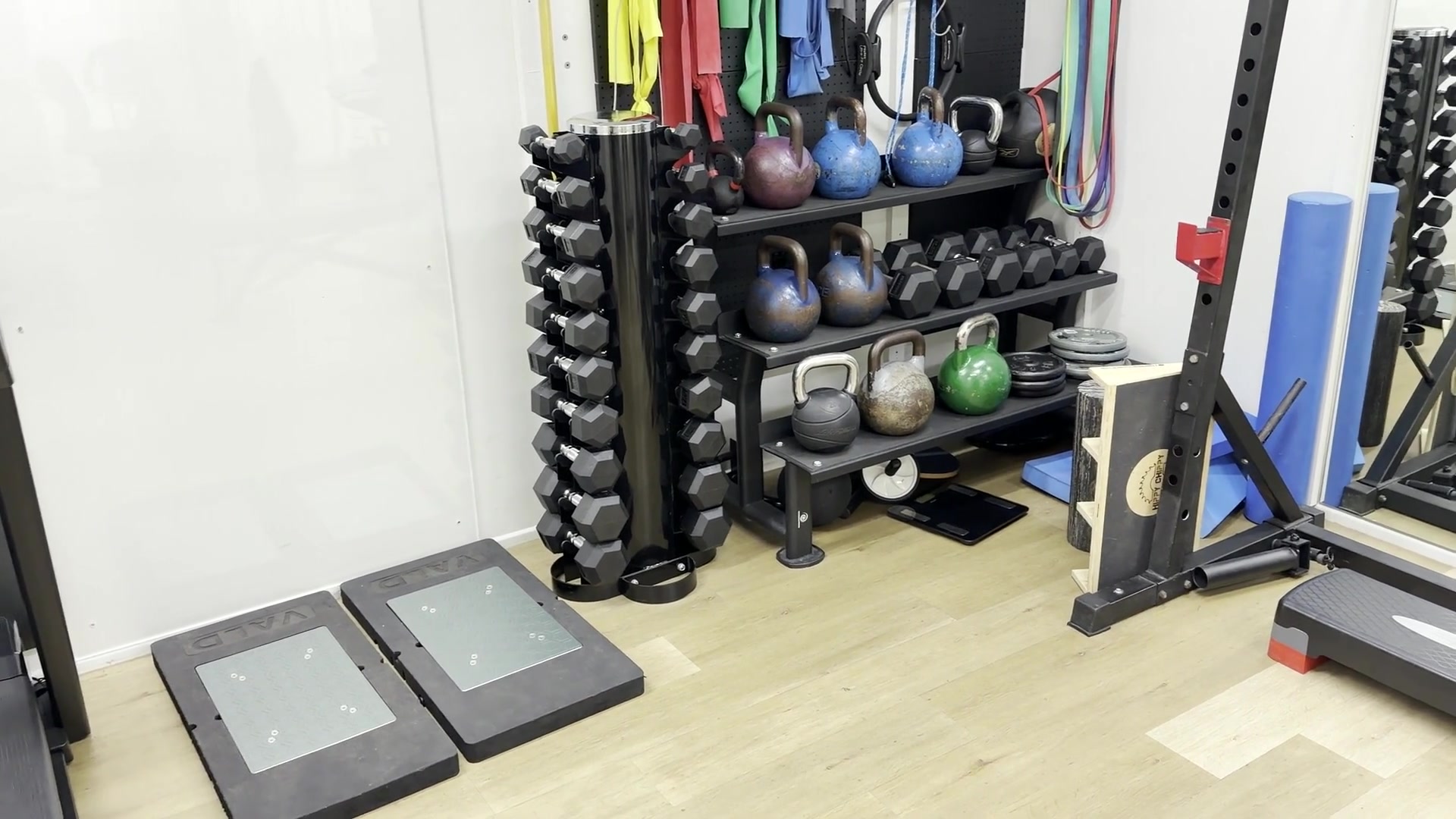
This is the kind of work our team does every day in the clinic gym. If you’re in your 40s and your cycle is changing, a physio can build you a lifting program that starts where you are — even if you’ve never touched a barbell — and progresses the load safely toward the range the research supports, usually as part of a gym-based rehab plan. Where it changes what we recommend, VALD force-plate testing measures leg power and left-right differences you can’t see by eye.
Two things generic programs miss. If you have low bone density, a prolapse or leaking under load, the lifts still work — they just need modifying, and our women’s pelvic health physio can be part of the plan. And if you’re losing weight on a GLP-1 medication, protect your muscle at the same time; we’ve written about that here.
One more number. Bone density sits alongside grip strength, leg power and balance as markers of how well you’ll age — and they all respond to the same training. See the five numbers that predict how well you’ll age.
To get started, book an appointment online or call 07 3209 2000 and tell reception you want to build strength through perimenopause. Daisy Hill Physio is at U4 11–13 Allamanda Dr, Daisy Hill QLD 4127, in Logan City south of Brisbane — Logan, Queensland, not Logan, Utah. Email info@daisyhillphysio.com.au.
This guide is general information and doesn’t replace an individual assessment. If you have a known fracture, unexplained back pain, sudden height loss, or a scan showing osteoporosis, see your GP before starting a heavy lifting program, and tell your physio so the plan can be adjusted.
Reviewed by Teya Williams, Physiotherapist (healthy ageing, bone health and strength training), and Karly Flynn, Physiotherapist (women’s pelvic health and female athlete strength), Daisy Hill Physio. Updated 18 September 2026.
Sources: Study of Women’s Health Across the Nation (SWAN), Bone Health over the Menopause Transition fact sheet, summarising Greendale GA et al., J Bone Miner Res 2012;27(1):111–118 and Shieh A et al., J Clin Endocrinol Metab 2021;106(7):e2491–e2501 (swanstudy.org). Yun H et al., “Optimal resistance training parameters for improving bone mineral density in postmenopausal women: a systematic review and meta-analysis,” Journal of Orthopaedic Surgery and Research 2025;20:523. Jones E, Starrs P, Hunter B, “A systematic review and meta-analysis of the effects of high-intensity, impact, and strength training on bone mineral density in premenopausal and postmenopausal women,” Menopause, published online 11 August 2026. Watson SL, Weeks BK, Weis LJ, Harding AT, Horan SA, Beck BR, “High-intensity resistance and impact training improves bone mineral density and physical function in postmenopausal women with osteopenia and osteoporosis: the LIFTMOR randomized controlled trial,” J Bone Miner Res 2018;33(2):211–220. All sources accessed 18 September 2026.